Introduction to Modulation and Demodulation
Wireless communication refers to the process of converting data into wireless signals for transmission, and then recovering the original data from the received wireless signals at the receiver. This process generally involves several steps: encoding, modulation, transmission, demodulation, and decoding. As illustrated in the figure below:
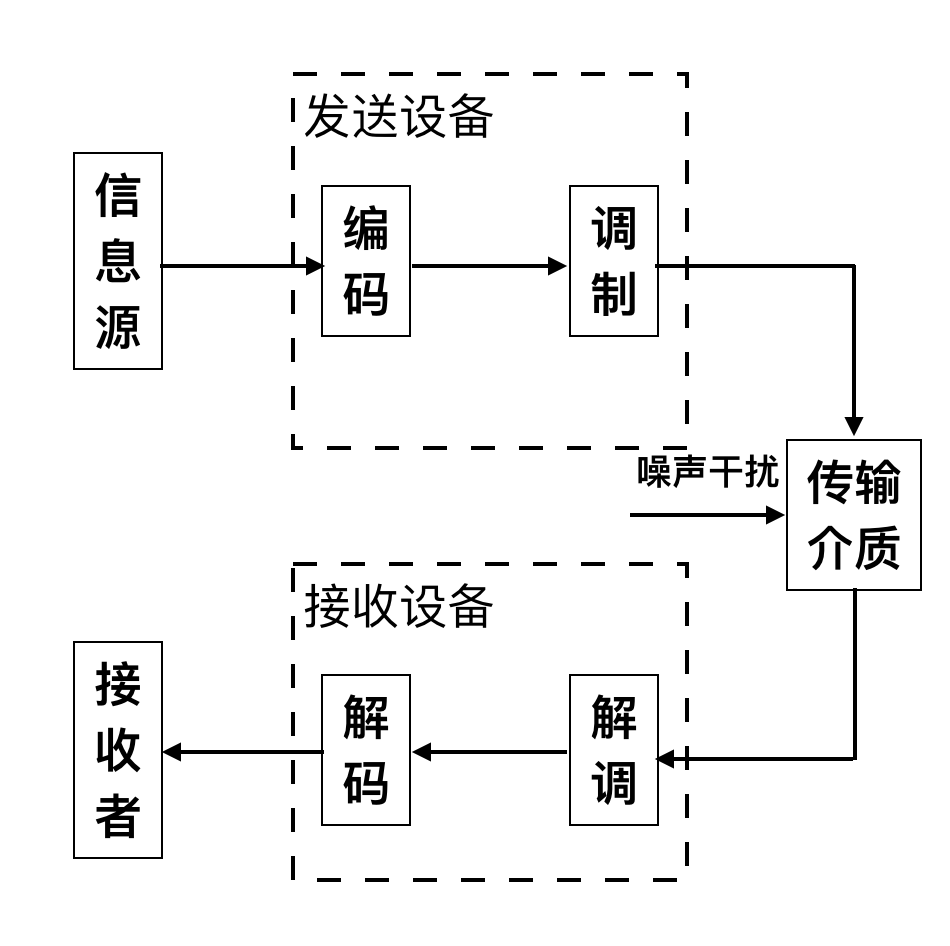
Before transmitting data, certain encoding techniques are applied to enable error detection and correction. For example, CRC (Cyclic Redundancy Check), error-correcting codes, or Gray coding may be added. In this section, we will primarily focus on the processes of modulation and demodulation. Modulation is the process of converting encoded information—typically represented as a binary sequence—into a signal suitable for transmission. Demodulation is the reverse process, where the received signal is converted back into a binary sequence. Later, using a complete protocol implementation as a case study, we will explain the entire communication process.
In simple terms, suppose we want to transmit a binary sequence such as 01011100 using a device that sends signals like sinusoidal waves. The modulation process defines how this binary data is transformed into a physical signal—for instance, by adjusting parameters to alter the shape of a sine wave, or by superimposing multiple sine waves. The key question is: what kind of signal should we send, or how should we design the transmitted signal, so that the receiver can correctly interpret it as the binary sequence 01011100?
To ensure the receiver can recover the transmitted binary sequence from the received signal, a straightforward idea is to use two distinct sinusoidal signals with different parameters to represent "0" and "1". As long as the sender and receiver agree in advance on which signal corresponds to which binary symbol, they can distinguish the transmitted data. To generate distinguishable sinusoidal signals, let's first examine the mathematical expression of a sine wave shown in the following figure:
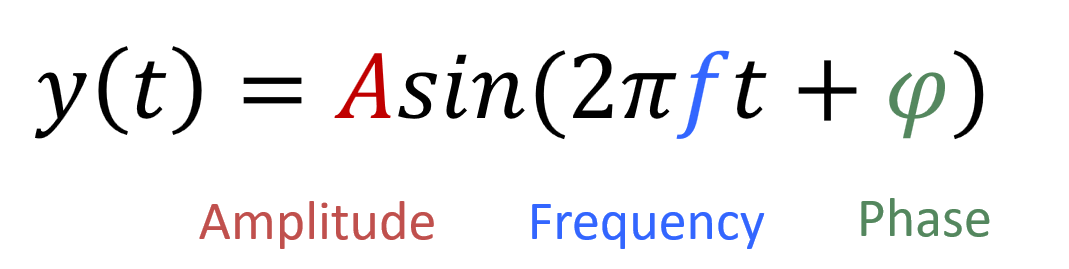
As can be seen, different sine waves can be generated by altering the amplitude, frequency, or phase of the sine function. These three characteristics correspond directly to three common modulation techniques: Amplitude Modulation (AM), Frequency Modulation (FM), and Phase Modulation (PM). Additionally, other features such as the time interval between transmitted sine waves can also be used to represent binary symbols.
This chapter introduces the fundamental steps of modulation and demodulation, along with several commonly used modulation and demodulation methods. With a solid understanding of these techniques, one can implement a basic wireless communication system at the code level.
References
- Signals and Systems (Second Edition)